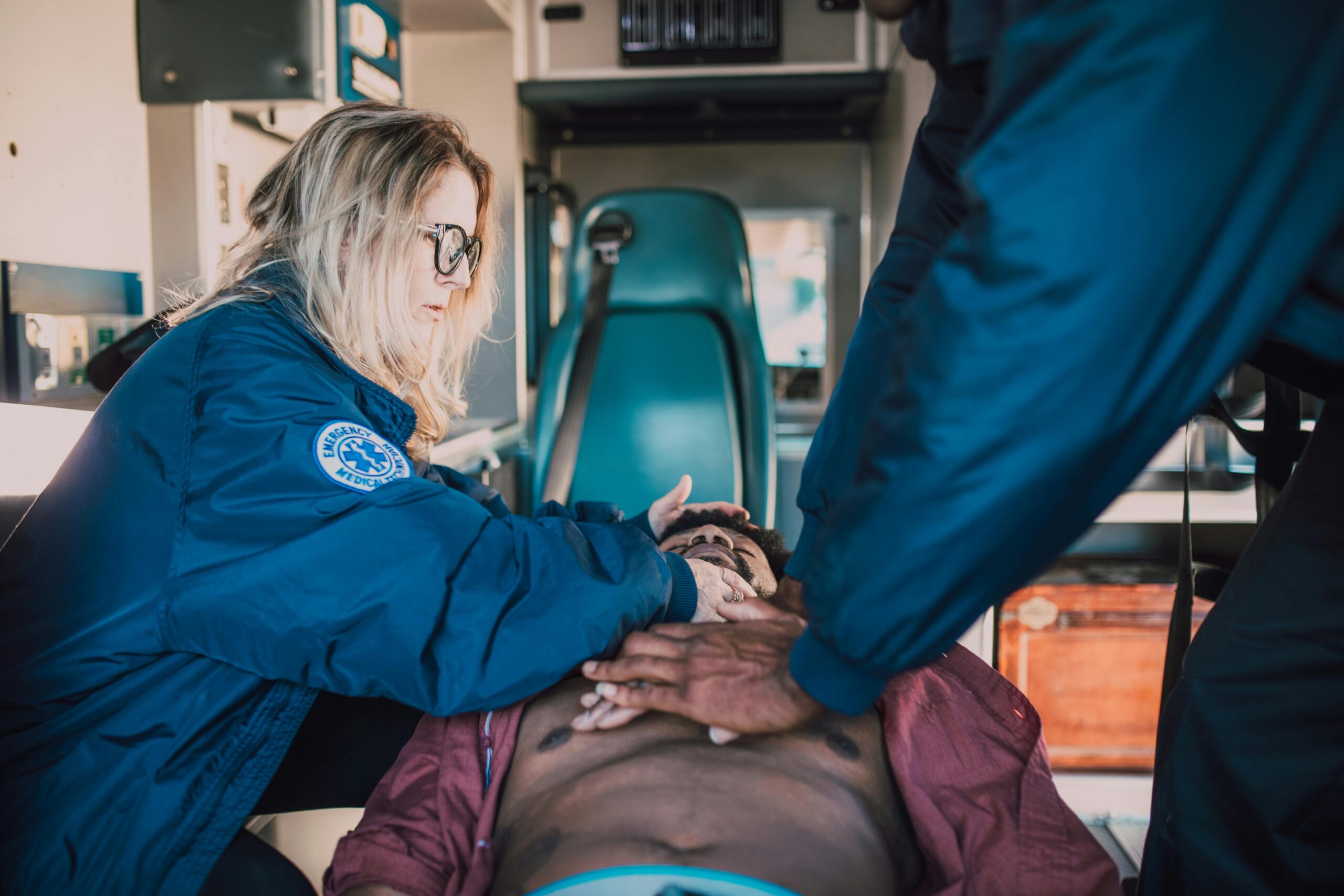
Cardiac arrest is a serious condition in which oxygenated blood stops flowing through the body. The brain is most sensitive to oxygen deprivation, and permanent damage occurs within minutes if resuscitation is not started. Therefore, it is very important to recognize cardiac arrest as quickly as possible and resuscitate the victim until the emergency services arrive. Instructions can be found on this website.
Do not be afraid to resuscitate, you cannot hurt the victim any more. If they do not resist, they need your help!
Professional resuscitation (by emergency services, hospital medical staff) requires a range of equipment and medications. The correct procedure depends on the heart rhythm. Even during cardiac arrest, the heart may still beat, but it is no longer pumping blood effectively. This condition is called ventricular fibrillation. In ventricular fibrillation (and some other conditions), it is necessary to administer a defibrillation shock as soon as possible and then repeat it at regular intervals until circulation is restored, while compressing the chest. If the heart is not moving at all (a flat line on the ECG), this condition is called asystole. In asystole, it makes no sense to defibrillate the heart, but chest compressions are performed and medication is administered.
Mechanical circulatory support methods have also recently been used in the treatment of cardiac arrest, in particular connection to extracorporeal membrane oxygenation (ECMO) as a bridge to the restoration of the heart’s own activity. ECMO devices were widely discussed, for example, during the COVID-19 pandemic. This is a device that oxygenates the patient’s own blood and pumps it back into the bloodstream. The use of ECMO in resuscitation is still in the testing phase and is not widely available, but there are facilities in the Czech Republic that are among the most advanced in the world in using this method.
Patients who suffer cardiac arrest often experience serious consequences. These can be purely physical, but they are often psychological in nature. Due to reduced oxygenated blood flow to the brain, they may have problems with memory, thought processes, mood, or movement. A longer stay in the intensive care unit also contributes to the damage. In the case of psychological problems, it is advisable to seek help from a psychologist and other specialists.
Did you know that:
Out-of-hospital cardiac arrest occurs in 35–40 individuals per 100,000 population per year, while in-hospital cardiac arrest occurs in 1–5 cases per 1,000 hospitalizations?
the chance of survival until discharge is approximately 10% for out-of-hospital cardiac arrest, while for in-hospital cardiac arrest, survival is slightly higher at 15–20%?
in Prague, cardiac arrest affects 500–700 people per year?
With every minute that a patient in cardiac arrest does not receive help, the chance of survival decreases by 10%?
The most common cause of cardiac arrest is a heart rhythm disorder, which can be relatively easily treated with a defibrillator if it is available in time?
Early lay assistance doubles or triples the chance of survival?